Rod rating
Does the rod power and lure range suit your target species?
Many fishing games let you mix and match gear, and the choices can feel overwhelming. This guide explains how to think about balance so each part of your virtual setup supports the others.
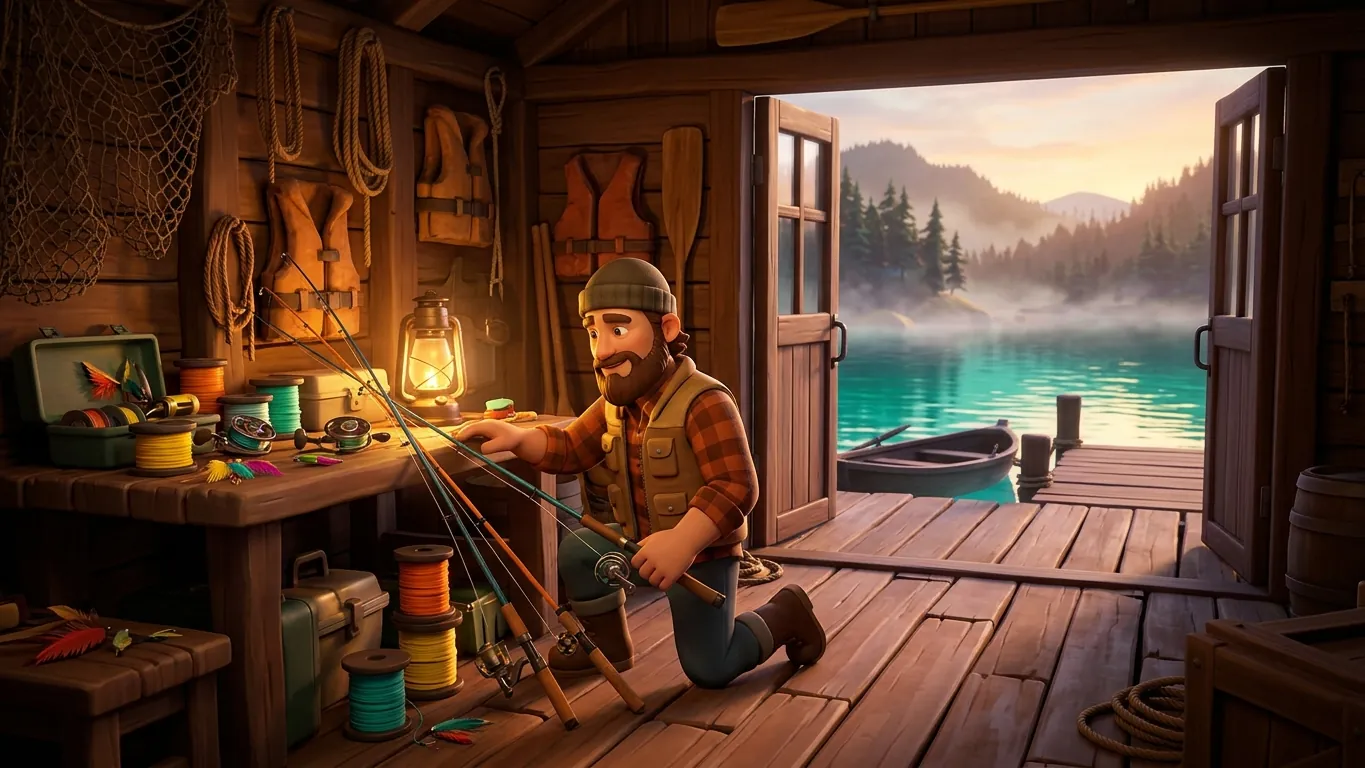
In games with detailed tackle systems, it is tempting to buy the strongest rod and reel you can afford and assume the rest will follow. In practice, your setup is only as strong as its weakest link. A heavy rod paired with thin line will still snap when a fish pulls hard. A light rod with very heavy line may not cast well or may break the rod itself in games that model it.
Balanced gear means each part, rod, reel, line, leader, hook and lure, is rated for a similar range of strength and weight. When those ranges overlap, the setup behaves predictably.
Before changing anything, decide what you want to catch and where. Small panfish in a calm pond need very different gear from a strong saltwater species in rough surf. Many games give clues about species size, preferred depth and favorite food. Use that information as your starting point.
Once you know the target, choose a rod whose power and lure range fit it. Then pick a reel that matches the rod size and can hold enough line of the strength you need. Choosing in this order keeps decisions simple.
Line is often where virtual anglers lose fish. Many games distinguish between line types that resemble real ones, such as monofilament, which stretches and is forgiving; fluorocarbon, which is less visible in water; and braided line, which is very strong for its thickness but has little stretch.
A common approach in both real and virtual fishing is to use a stronger main line with a slightly lighter or less visible leader near the hook. If the game supports leaders, experiment with them for wary species in clear water.
Hook size should match the bait and the fish. A hook that is too large may scare fish away or fail to fit in a small mouth, while one that is too small may straighten or pull free on a bigger catch.
Even perfectly matched gear can fail if drag is set poorly. Many games let you adjust drag on the reel. A useful habit is to set it so line begins to slip somewhere below the breaking strength of your weakest component. That way the reel gives line during sudden runs instead of letting it snap.
Watch the tension indicator closely during a fight. If it rises quickly, stop reeling and let the drag work. When the fish slows, resume steady retrieval. Patience usually beats force.
Before heading out in your game, run through these points.
Does the rod power and lure range suit your target species?
Is the reel sized for the rod and able to hold enough of your chosen line?
Is the line within the range recommended for both rod and reel?
Do your hooks, leader and lure fit the species and water clarity?
Is the drag set to slip before your weakest component would fail?
 Reading the water
Learn how structure, depth, current, temperature and light affect where fish hold, with tips that apply to real lakes, rivers and fishing games.
Read more
 Fishing around the world
An overview of the kinds of fishing waters anglers travel to around the world, from mountain streams to tropical flats, and what each one asks of you.
Read more
 Planning a fishing trip abroad
A step-by-step checklist for planning a fishing trip abroad, covering research, permits, tackle, packing, safety and respect for local waters.
Read more