Rods and reels explained
Rods and reels are the foundation of any tackle setup, real or virtual. This article explains the main terms in plain language so you can understand what you are looking at.
Why the rod and reel matter
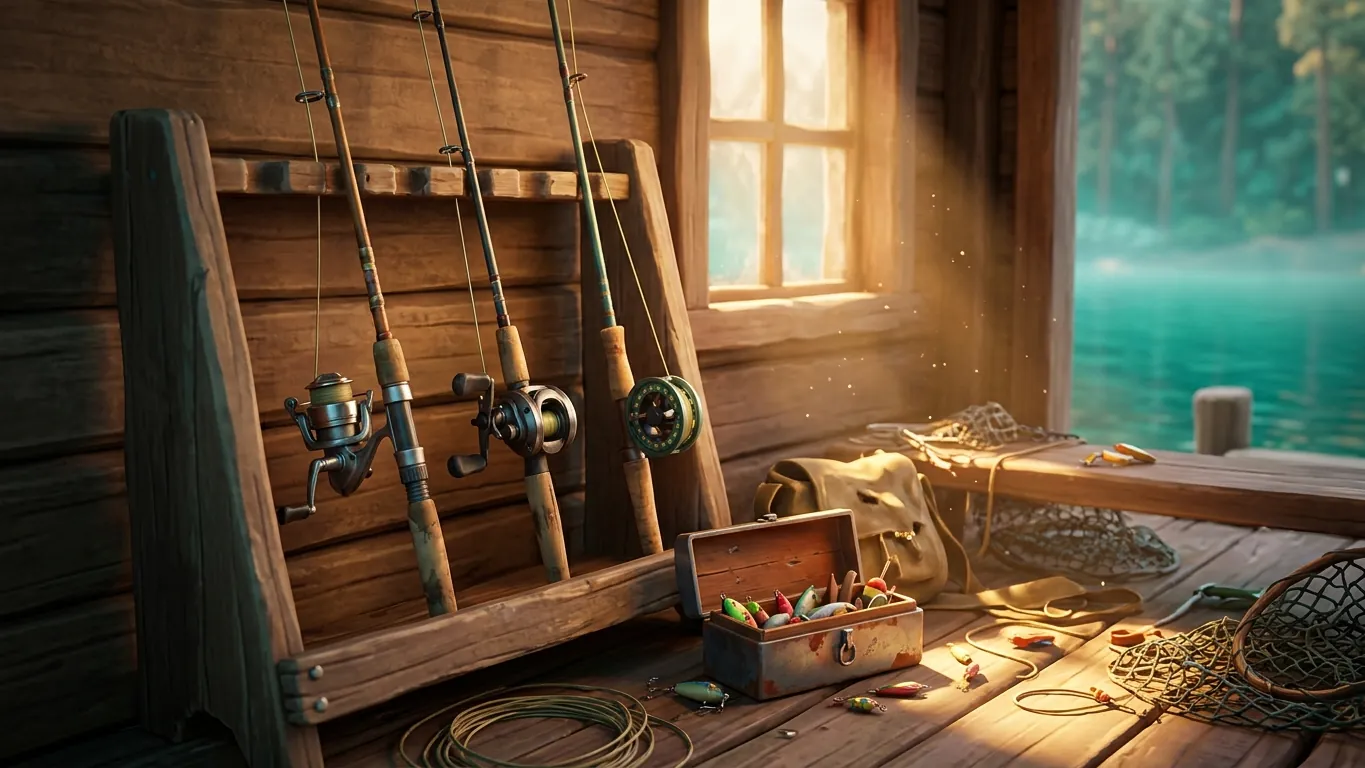
Your rod and reel determine how far and accurately you can cast, how well you feel what is happening at the end of the line and how much control you have when a fish pulls back. They are designed to work with a certain range of line strengths and lure weights. When the parts match, fishing feels smoother. When they do not, casting becomes awkward and line breaks more often.
You do not need to memorize every specification. Understanding a few core ideas, length, power and action for rods, and the main reel types, will cover most situations.
Rod length, power and action
Length affects casting distance and control. Longer rods generally cast farther and help when fishing from shore. Shorter rods are easier to handle in tight spaces, such as small streams or boats, and can feel more precise.
Power describes how much force it takes to bend the rod. Lighter power rods suit small fish and light lures, while heavier power rods handle bigger fish and heavier lures. Matching power to your target species and lure weight is one of the most important choices.
Action describes where the rod bends. A fast-action rod bends mostly near the tip and gives quick hook sets and good sensitivity. A slow-action rod bends deeper toward the handle and is more forgiving, which can help keep small hooks from pulling free. Moderate action sits between the two and is a common all-round choice.
Spinning reels and baitcasting reels
Spinning reels hang beneath the rod and have a fixed spool. They are widely considered easier to learn because the line rarely tangles on the cast. They work well with lighter lures and lines, which makes them a popular choice for beginners and for general freshwater fishing.
Baitcasting reels sit on top of the rod and have a spool that turns as line goes out. They can offer excellent accuracy and control with heavier lures, but they take practice. If the spool spins faster than the line leaves, it can create a tangle often called a backlash. Many anglers learn on spinning gear before trying baitcasters.
There are other reel types too, such as spincast reels, which are very simple, and fly reels, which are used with a completely different casting technique. Each has its place.
Drag, gear ratio and line capacity
Drag is a friction system inside the reel that lets line slip out when a fish pulls hard. Set too tight, the line may break. Set too loose, the fish can run freely and you lose control. A common habit is to set drag so the line slips well before it reaches its breaking strength.
Gear ratio describes how many times the spool turns for each turn of the handle. Higher ratios retrieve line faster, which suits lures that need quick movement. Lower ratios retrieve more slowly but with more winding power. Line capacity simply tells you how much line of a given strength the spool can hold.
Building a balanced first setup
For many beginners, a medium-length spinning rod with medium-light or medium power and a moderate or fast action, paired with a matching spinning reel, is a flexible starting point for common freshwater species. Check the rod for its recommended line and lure weight range and choose line within that range.
The same logic applies in fishing games that model tackle. If your virtual rod and reel are rated for different line strengths, the weakest part tends to fail first. Balance your setup, and both real and virtual fishing become more enjoyable. If you are unsure, staff at a local tackle shop or an experienced angler can help you choose gear suited to your waters.
Related articles
 Building a balanced tackle setup in fishing games
Learn how to combine rods, reels, lines and lures in fishing video games so your gear works together and lost fish become less frequent.
Read more
 Reading the water
Learn how structure, depth, current, temperature and light affect where fish hold, with tips that apply to real lakes, rivers and fishing games.
Read more
 Fishing around the world
An overview of the kinds of fishing waters anglers travel to around the world, from mountain streams to tropical flats, and what each one asks of you.
Read more